


Syntax and Morphology Study Guide for Language Change
Original price was: 179.00 $.139.00 $Current price is: 139.00 $.
A structured, searchable knowledge base module that maps syntax and morphology across stages of Arabic language change — designed for students, researchers, and professionals who need fast, reliable reference and practical examples.
Key benefits & value for the buyer
This syntax and morphology KBM transforms scattered readings into a compact, connected reference. Instead of re-reading multiple articles, you get:
- Time savings: find the rule or morphological pattern within seconds — ideal for exam time pressure or drafting papers.
- Structured learning path: follow a clear hierarchy from basic syntactic categories to advanced morphophonological change.
- Reliability: entries include source pointers and example citations so you can trust and verify quickly.
- Actionable examples: annotated sentence analyses, paradigm tables, and diachronic change timelines you can copy into assignments or presentations.
For students and researchers who need a dependable “one-stop” for Arabic grammar rules, this KBM reduces cognitive load and speeds decision-making.
Use cases & real-life scenarios
Undergraduate student — exam revision
Quickly review clause types, agreement rules, and common morphological paradigms. Use the printable PDFs for last-minute study and the integrated exercises to test recall.
Graduate researcher — literature synthesis
Extract cross-referenced examples of syntactic change across corpora, export JSON nodes for inclusion in a methodology appendix, and generate citation-ready summaries for your literature review.
Instructor — course design
Use the hierarchical modules to assemble lecture sequences, adapt exercises for different levels, and provide students with a searchable reference they can rely on beyond the semester.
Language technologist / NLP professional
Import morphological paradigms (CSV/JSON) into annotation tools or rule-based parsers to accelerate dataset preparation and testing.
Who is this product for?
This KBM is tailored for:
- Humanities students preparing exams in Arabic grammar and syntax.
- Researchers focusing on language change, historical syntax, and morphology.
- Teachers designing modules on Arabic grammar rules and morphology.
- Translators and language engineers needing authoritative morphological references.
- Professionals who require quick, structured access to learn Arabic syntax for applied tasks.
How to choose the right KBM version
We offer editions that differ by depth and format. Choose based on your workflow:
- Student Edition: concise nodes, study exercises, printable PDFs. Best if you want quick review and exam practice.
- Researcher Edition: extended node sets, diachronic corpora links, exportable JSON and CSV. Best if you need to integrate data into analysis.
- Instructor Pack: lecture-ready slides, assignments, and answer keys organized by module. Best for course design.
If unsure, preview the free module sample (index + 3 nodes) to confirm fit.
Quick comparison with typical alternatives
Alternatives include traditional textbooks, scattered journal articles, and online forums. Compared to those:
- Books: deep but linear and static. KBM provides modular, searchable access and exportable data.
- Articles: focused but siloed. KBM connects related findings and provides an overview without redundant reading.
- Forums: fast but unverified. KBM cites sources and offers curated examples for accuracy.
Best practices & tips to get maximum value
- Start with the hierarchical overview to orient your study, then drill into nodes for examples and exercises.
- Use CSV/JSON exports to integrate morphological paradigms into your analysis pipeline.
- Print selected modules for offline revision — the PDFs are optimized for two-column study notes.
- Keep one KBM edition per course or project to avoid fragmentation; link between KBMs when broader scopes overlap.
Common mistakes when buying or using grammar modules — and how to avoid them
- Buying the wrong depth: choose an edition (Student vs Researcher) that matches your goals; use the preview to confirm.
- Assuming one source is enough: use KBM as a curated hub and follow its citations for deeper readings when needed.
- Ignoring format needs: if you require machine-readable data, ensure you select the JSON/CSV-enabled edition.
Product specifications
- Title: Syntax and Morphology Study Guide for Language Change
- Primary focus: syntax and morphology (Arabic)
- Formats included: PDF (print-ready), JSON (hierarchical nodes), CSV (paradigms), HTML export
- Hierarchy levels: 4 (Concept → Rule → Examples → Diachronic Cases)
- Nodes & entries: 1,200+ curated nodes, 600+ annotated sentence examples
- Language: Arabic (primary content) with English glosses and summaries
- Compatibility: usable in reference managers, corpus tools, LMS imports
- License: single-user digital license; multi-user institutional licenses available
- Updates: free minor updates for 12 months; paid extended updates optional
FAQ
Is this a book or a database? Can it replace textbooks?
What formats do I get and how do I use them in research tools?
How reliable are the grammar rules and historical examples?
What if the KBM doesn’t match my exact course or research topic?
Ready to streamline your study or research?
Get immediate access to a structured, citation-ready reference for syntax and morphology. Whether you need quick rules, diachronic examples, or machine-readable paradigms, this KBM was built to save time and increase accuracy.
Still unsure? Download the free preview module from the product page and test the search, exports, and sample exercises before you buy.
Related products
Analytical Chemistry Book: Qualitative and Quantitative Methods Guide
Astrophysics Book: Understanding Stars, Galaxies, and Dark Energy
A searchable, hierarchical Knowledge Base Module (KBM) that converts astrophysics and cosmology into a practical, exam-ready and research-ready reference. Designed for students, researchers, and professionals who need immediate access to reliable explanations, equations, and data models for stars, galaxies, and dark energy.
Biological Anthropology Study Guide on Human Evolution
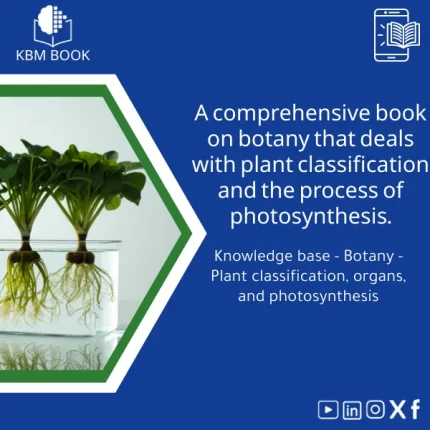
Comprehensive Botany Book on Plant Taxonomy and Photosynthesis
A structured, searchable botany book designed as a Knowledge Base Module (KBM) — an end-to-end reference on plant taxonomy, organ structure, and the biochemistry of photosynthesis. Built for students, researchers, and professionals who need reliable, hierarchical knowledge they can search, cite, and apply immediately.
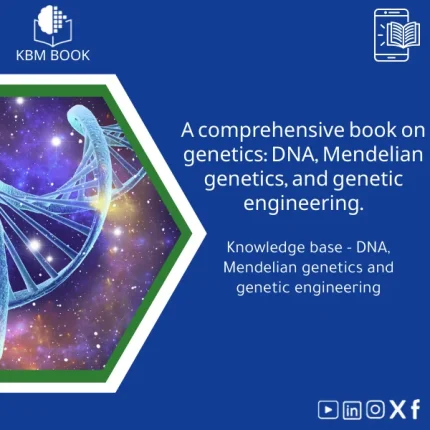
Comprehensive Genetics Book: DNA, Mendelian Genetics & Engineering
A structured, searchable knowledge base module (KBM) that turns genetics theory and practice into an immediately usable digital reference — from DNA structure to Mendelian genetics and contemporary genetic engineering techniques — optimized for students, researchers, and professionals who need reliable answers fast.
General Physics Book: Fundamentals of Force, Motion, Energy
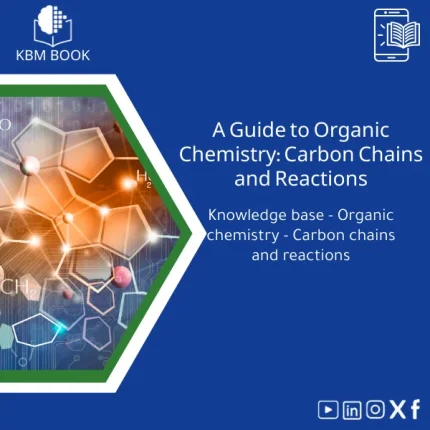
Organic Chemistry Guide: Carbon Chains and Reactions
Thermal Physics Guide: Understanding Heat, Energy, and Entropy
A downloadable, hierarchically structured Knowledge Base Module (KBM) that converts university-level thermodynamics into a searchable, practical digital database. Ideal for students, researchers, and professionals who need fast, reliable access to fundamentals and advanced topics in thermal physics.
Reviews
Clear filtersThere are no reviews yet.