


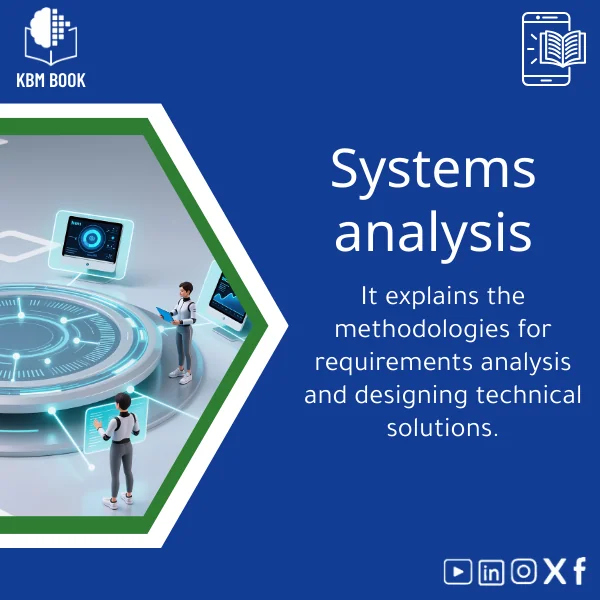
Systems Analysis Guide: Requirements and Technical Solutions
Original price was: 179.00 $.139.00 $Current price is: 139.00 $.
A compact, hierarchical Knowledge Base Module (KBM) that turns systems analysis theory into a searchable, ready-to-use database covering requirements analysis methods and technical solution design — ideal for students, researchers, and professionals who need accurate, structured information fast.
Key benefits & value for the buyer
This systems analysis KBM converts fragmented knowledge into a single, consistent reference you can search, copy, and adapt. Instead of reading chapters, you query modules: business rules, stakeholder maps, requirement elicitation scripts, use case templates, non-functional requirements checklists, architecture options, and implementation trade-offs.
Benefits translated from features
- Structured access: Hierarchical taxonomy reduces lookup time — find the right requirements analysis method in seconds.
- Actionable templates: Ready-to-use artifacts (UML snippets, acceptance criteria, decision matrices) that save hours in planning and documentation.
- Cross-disciplinary links: Connect systems analysis to testing, deployment, and maintenance practices for complete project continuity.
- Reliable sources: Methods and patterns referenced to standard literature and industry practice so you can trust decisions and citations.
Use cases & real-life scenarios
Practical examples of how the systems analysis KBM is used day-to-day:
- Students: Build lab reports and term projects quickly — reuse requirement templates, map use cases, and export diagrams to submit with assignments.
- Researchers: Structure literature reviews by mapping requirement patterns, traceability matrices, and gap analyses for reproducible studies.
- System architects & developers: Select technical solution candidates against constraints (cost, latency, scalability), and produce concise solution briefs for stakeholders.
- Consultants & trainers: Use the KBM as a standardized training module to teach requirements analysis methods and to supply workshop exercises that scale.
Example scenario: a small team needs a quick decision between a microservices and monolith approach. Use the KBM to pull the comparative template, populate constraints (team size, SLA, release cadence), and generate a recommendation report in under an hour.
Who is this product for?
The KBM is tailored for “students, researchers, and professionals who need structured knowledge databases across various fields for quick access to reliable information.” Specifically:
- Computer science and IT students preparing assignments or exams on systems analysis and information systems analysis.
- Researchers needing a compact reference for requirements analysis methods and reproducible artifacts.
- Business analysts, systems engineers, and project managers who must translate stakeholder needs into technical solutions.
How to choose the right KBM version
Versions vary by depth and format. Choose based on your workflow:
- Starter (PDF + templates): Best for students and quick reference.
- Professional (editable formats): Includes JSON/CSV exports, editable UML, and extended solution blueprints — ideal for practitioners integrating with tools.
- Research pack: Adds citation-ready notes, method provenance, and reproducible study templates for academic work.
Need a recommendation? If you work on real projects or plan to integrate KBM content into tools, choose Professional. For coursework, Starter is cost-effective and complete.
Quick comparison with typical alternatives
Compared with books, articles, or scattered templates, this KBM emphasizes:
- Search & reuse: Databases are indexed and modular vs. linear text.
- Practical artifacts: Ready-to-insert templates vs. conceptual discussions.
- Consistency: One taxonomy across requirements analysis methods, avoiding duplication or conflicting definitions common in blogs or PDFs.
Best practices & tips to get maximum value
- Start with the “Stakeholder & Scope” module to ground analysis before exploring solutions.
- Use traceability templates from the KBM to link requirements to tests early — prevents scope creep.
- Export decision matrices into your project tool and update them as constraints change — KBMs are living references, not one-off reads.
- When teaching, assign specific modules as pre-reading and use the included exercises for hands-on sessions.
Common mistakes when buying/using similar products and how to avoid them
- Expecting a narrative book: KBMs are databases; expect modular, query-first content. Avoid if you only want long-form prose.
- Skipping version notes: Always check the update log — requirements practices evolve and the KBM includes versioned changes.
- Ignoring license limits: Verify whether your use requires commercial licensing for redistribution or team-wide sharing.
Product specifications
- Title: Systems Analysis Guide: Requirements and Technical Solutions
- Format: Downloadable KBM package (PDF, editable UML, CSV/JSON exports)
- Modules: Hierarchical modules covering stakeholder analysis, elicitation scripts, functional & non-functional requirements, solution patterns, trade-off matrices, test mapping
- Artifacts included: 20+ templates, 15 decision matrices, 30+ UML/snippets, example requirements sets
- Language: English
- Delivery: Instant digital download after purchase
- License: Single-user / Team (choose at checkout)
- Compatibility: Importable into common text editors, modeling tools, and project management platforms
- Usage notes: Editable artifacts intended for adaptation to local projects and citation in academic work
Frequently asked questions
Is this a systems analysis book or an interactive database?
What formats are included — can I edit diagrams and export data?
Will this KBM cover information systems analysis and technical architecture?
How do I know the methods are reliable?
Get the Systems Analysis KBM
Ready to replace scattered notes and lengthy searches with a structured, actionable systems analysis resource? The KBM saves time, standardizes your process, and produces repeatable outcomes for coursework, research, and projects.
Instant download • Multiple editable formats • Choose single-user or team license at checkout
Related products
Biochemistry Book: Understanding Chemical Processes in Living Systems

Cell Biology Guide: Structure, Division, and Transport Insights

Classical Mechanics Guide: Newton’s Laws and Dynamics
A searchable, hierarchical Knowledge Base Module (KBM) that turns classical mechanics into a practical, ready-to-use reference for fast problem solving, lecture preparation, and applied engineering. Designed for students, researchers, and professionals who need precise access to Newton’s laws, rotational motion, and applied dynamics without the noise of textbooks.
Comprehensive Genetics Book: DNA, Mendelian Genetics & Engineering
A structured, searchable knowledge base module (KBM) that turns genetics theory and practice into an immediately usable digital reference — from DNA structure to Mendelian genetics and contemporary genetic engineering techniques — optimized for students, researchers, and professionals who need reliable answers fast.

Electromagnetism Book: A Comprehensive Guide to Fields and Circuits

Materials Physics Guide: Understanding Solid-State Properties

Quantum Mechanics: A Beginner’s Guide to Superposition and Waves

Thermal Physics Guide: Understanding Heat, Energy, and Entropy
A downloadable, hierarchically structured Knowledge Base Module (KBM) that converts university-level thermodynamics into a searchable, practical digital database. Ideal for students, researchers, and professionals who need fast, reliable access to fundamentals and advanced topics in thermal physics.
Reviews
Clear filtersThere are no reviews yet.