


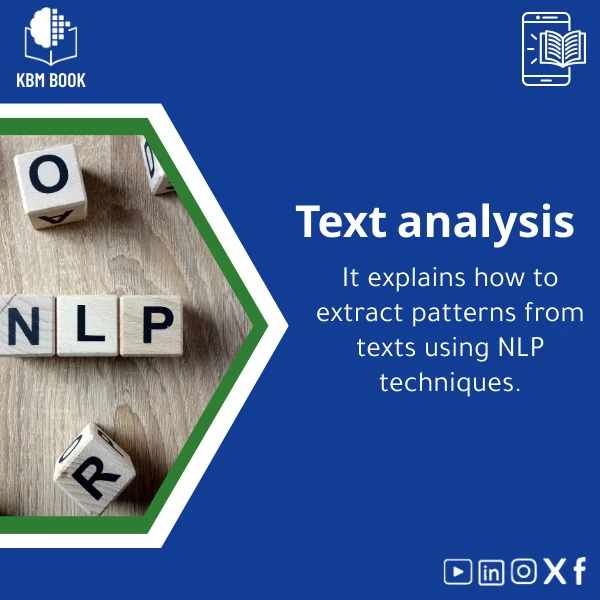
Text Analytics Guide for NLP Techniques and Pattern Mining
Original price was: 179.00 $.139.00 $Current price is: 139.00 $.
A structured, hierarchical knowledge-base module (KBM) that turns text analytics methodology into repeatable, searchable tools — templates, checklists, worksheets and annotated examples for fast, reliable text data analysis.
Key benefits & value for students, researchers and professionals
This text analytics KBM converts scattered knowledge (papers, code snippets, ad-hoc notes) into a usable, repeatable resource. Instead of a long tutorial or a static book, you get an organized database of modules that you can search, filter and export — so you spend time analyzing results, not hunting for methods.
Concrete benefits
- Faster setup: Templates and a ready NLP text mining checklist reduce experiment setup time by providing standardized preprocessing and evaluation steps.
- Consistency: A text data analysis form and content analysis worksheet enforce consistent coding and feature extraction across projects or students.
- Reproducibility: Hierarchical modules include recommended parameters and evaluation procedures so results can be reproduced or audited.
- Transferable knowledge: Use modules as lecture material, team SOPs, or pipeline blueprints for production or research code.
Use cases & real-life scenarios
Student — structured literature review
A graduate student maps topic modeling options and applies the content analysis worksheet to extract variables for thesis experiments. The KBM’s checklist ensures preprocessing decisions (tokenization, stop-word strategy) are recorded and comparable across datasets.
Researcher — reproducible experiments
A researcher uses the text analytics template to standardize feature extraction and evaluation across multiple corpora. The KBM’s module on pattern mining documents approach alternatives (n-grams, embeddings + clustering), expected outputs, and evaluation metrics.
Professional — product & marketing insights
A product analyst runs sentiment and topic detection workflows using the ready-to-fill text data analysis form, producing consistent dashboards and exportable summaries for stakeholders.
Who is this product for?
- Students learning applied NLP who need guided, repeatable exercises.
- Researchers who require documented, auditable text-mining procedures.
- Data scientists and analysts who need templates to operationalize text analytics pipelines.
- Trainers and educators assembling course materials for text mining and content analysis.
How to choose the right KBM module for your needs
Choose based on three factors: scope, output format, and integration path.
- Scope: Pick the module covering your required techniques — e.g., classification & sentiment vs. unsupervised pattern mining (topic models, clustering).
- Output format: If you work mainly in spreadsheets, select modules that include the text data analysis form and Excel exports; if you use code-driven pipelines, prefer JSON/CSV exports and code snippets.
- Integration: Check the included examples and recommended scripts for Python/R compatibility if you plan to integrate into existing workflows.
Quick comparison with typical alternatives
Consider common approaches and why a KBM can be more effective:
- Books & articles: Good for theory but lack the structured, exportable templates and checklists required for reproducibility.
- Ad-hoc scripts: Fast but unstandardized — the KBM provides structure and documentation so teams can reuse methods reliably.
- Generic templates from forums: Fragmented and incomplete; KBM is curated, hierarchical, and focused on filling practical gaps (evaluation, preprocessing, annotation schemas).
Best practices & tips to get maximum value
- Start with the NLP text mining checklist before running experiments — it prevents common preprocessing errors.
- Use the content analysis worksheet to document coding decisions and inter-annotator agreements if you work with manual labels.
- Export the text data analysis form to CSV for version control and to feed directly into analysis scripts.
- Adapt modules: treat KBM content as canonical building blocks that you can copy into your notebooks and modify per project.
Common mistakes when buying/using text analytics resources — and how to avoid them
- Buying too generic a guide: Look for modules with concrete templates and checklists rather than vague high-level advice.
- Skipping documentation: Always use the included worksheets to capture preprocessing and model choices; otherwise, results are not reproducible.
- Assuming one-size-fits-all parameters: Use the KBM’s recommended ranges and validation steps rather than copying hyperparameters without testing.
Product specifications
- Product type: Knowledge Base Module (KBM) — Text Analytics
- Included artefacts: text analytics template, NLP text mining checklist, text data analysis form, content analysis worksheet, annotated examples
- Format: Downloadable CSV, Excel (.xlsx), JSON exports and printable PDF worksheets
- Modules: Preprocessing, Feature Engineering, Pattern Mining (topic modeling, clustering), Classification & Evaluation, Annotation & Coding
- Compatibility: Designed to be used with Excel, Python (pandas, scikit-learn, gensim), and R; code snippets included for integration
- Delivery: Instant digital download after purchase — organized, searchable KBM files
- Usage notes: License for personal, academic and internal professional use (commercial redistribution requires separate license)
FAQ
What file formats are included and how do I use them?
The KBM includes CSV and Excel forms for data entry and annotation, JSON exports for pipeline integration, and printable PDF worksheets. Use CSV/Excel to collect and standardize your text variables, then import into Python or R for analysis. JSON exports are ready to plug into automation.
Do I need special software to use the templates?
No special software is required to use the worksheets — Excel or any spreadsheet reader can open the forms. For full pipeline examples, a standard Python or R environment is recommended; code snippets are provided and documented for straightforward use.
Is the KBM suitable for non-English datasets?
Yes. The KBM focuses on methodological structure (preprocessing, annotation schema, evaluation). Language-specific notes (tokenization, stop-words, stemming) are included for common languages, and the templates are language-agnostic.
What if the KBM doesn’t match my workflow exactly?
The KBM is modular: you can adopt only the parts you need (checklists, worksheets, production-ready exports). The hierarchical design makes it easy to copy, adapt and extend modules to fit specific projects.
Can I use this KBM for commercial projects?
The purchase includes a license for personal, academic and internal professional use. For redistribution, commercial reselling, or embedding within a commercial product, contact KBMBook for licensing options.
Ready to make your text analytics repeatable and auditable?
Get the Text Analytics Guide and start building standardized, reproducible workflows today. The KBM provides templates and checklists used by students, researchers and teams to reduce setup time and increase consistency.
Instant download. Includes templates (CSV/Excel/JSON), worksheets, annotated examples and integration notes for Python/R.
Related products
Analytical Chemistry Book: Qualitative and Quantitative Methods Guide
Comprehensive Genetics Book: DNA, Mendelian Genetics & Engineering
A structured, searchable knowledge base module (KBM) that turns genetics theory and practice into an immediately usable digital reference — from DNA structure to Mendelian genetics and contemporary genetic engineering techniques — optimized for students, researchers, and professionals who need reliable answers fast.
Comprehensive Nuclear Physics Book on Structure and Radioactivity

Electromagnetism Book: A Comprehensive Guide to Fields and Circuits
Inorganic Chemistry Guide: Bonding and Crystal Solids
A structured, searchable Knowledge Base Module (KBM) that converts inorganic chemistry fundamentals and advanced topics—bonding models, lattice structures, defects, and solid-state properties—into a practical digital reference for students, researchers, and professionals who need fast, reliable answers without wading through textbooks.
Organic Chemistry Guide: Carbon Chains and Reactions

Quantum Mechanics: A Beginner’s Guide to Superposition and Waves
Thermal Physics Guide: Understanding Heat, Energy, and Entropy
A downloadable, hierarchically structured Knowledge Base Module (KBM) that converts university-level thermodynamics into a searchable, practical digital database. Ideal for students, researchers, and professionals who need fast, reliable access to fundamentals and advanced topics in thermal physics.
Reviews
Clear filtersThere are no reviews yet.