


Time Series Analysis Guide: Forecasting with ARIMA Techniques
Original price was: 199.00 $.159.00 $Current price is: 159.00 $.
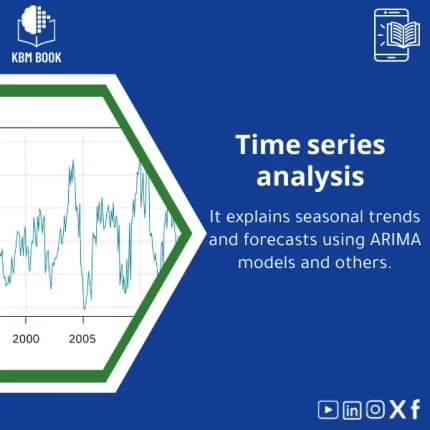
A practical, hierarchical KBM for mastering time series analysis and building reliable forecasts. Includes ready-to-use ARIMA model template, Excel time series template, and step-by-step demand forecasting sheets designed for students, researchers, and professionals who need fast access to structured, reproducible forecasting methods.
Key benefits & value for the buyer
From concept to deployable forecast
This KBM transforms fragmented time series knowledge into a searchable, repeatable workflow. Instead of scattered notes or one-off spreadsheets, you get an organized module that walks you from data preparation and seasonality detection to model selection, diagnostics, and forecast deployment. The emphasis is on utility: templates and sheets you can open, adapt, and use the same day.
Concrete outcomes
- Save hours: pre-built Excel time series templates eliminate repetitive setup for common forecasting tasks.
- Improve accuracy: guidance on differencing, ACF/PACF interpretation, and ARIMA parameter tuning reduces model mis-specification.
- Reproducible reports: annotated worksheets and example workflows make results auditable for academic and business contexts.
Use cases & real-life scenarios
Student — course project
A student uses the Excel time series template to analyze weekly sales data, follows the KBM’s step-by-step ARIMA tuning, and produces a reproducible methods appendix for a thesis. The KBM’s clear structure shortens learning time and increases the credibility of results.
Researcher — experiment replication
A researcher leverages the detailed diagnostics and example datasets to replicate published forecasts, ensuring stationarity checks and residual tests are correctly reported. The hierarchical KBM design makes it simple to trace each analytical decision.
Professional — demand forecasting
An analyst adapting a demand forecasting model uses the ready-to-use demand forecasting model sheet to generate rolling forecasts, compute prediction intervals, and feed results into inventory planning systems. The Excel templates are formatted to integrate with common reporting pipelines.
Who is this product for?
Targeted at students, researchers, and professionals who need structured, reliable knowledge and templates for time series analysis. Suitable for:
- Undergraduate and graduate students in statistics, economics, and data science
- Researchers needing reproducible forecasting methods
- Data analysts and demand planners seeking quick-to-deploy Excel templates
- Instructors who need teaching-ready examples and exercise sets
How to choose the right format and version
The KBM is delivered in multiple formats to match workflows:
- Excel (.xlsx) — full templates with formulas, charts, and validation steps. Best for non-programmers and business users.
- Annotated PDF — conceptual summaries and step guides for printing or sharing with supervisors.
- CSV example datasets — to import into R/Python for advanced analysis.
Choose Excel if you want immediate, hands-on forecasting without coding. Choose CSV + notes if you plan to replicate models in statistical software.
Quick comparison with typical alternatives
When evaluating options you might find textbooks, code notebooks, or ad-hoc templates. How this KBM differs:
- Textbooks explain theory but rarely provide ready-to-run business templates.
- Notebooks require programming knowledge and often lack structured step-by-step documentation for non-technical stakeholders.
- One-off spreadsheets are unstructured and hard to reuse or validate.
The KBM combines structured explanation, reproducible examples, and production-ready Excel templates — a middle ground that prioritizes speed, clarity, and verifiability.
Best practices & tips to get maximum value
- Start with the included example dataset to follow the full ARIMA workflow before applying to your own data.
- Use the diagnostics sheet to check residuals and recalibrate models quarterly — templates are organized to support regular updates.
- Document every change: use the KBM’s Notes section to keep parameter choices and assumptions auditable.
- Combine Excel outputs with visual dashboards for stakeholder communication — the templates export clean summary tables ready for reporting.
Common mistakes when buying/using similar resources and how to avoid them
- Buying a raw code notebook without documentation — avoid by choosing resources that include stepwise notes and examples.
- Assuming one model fits all series — the KBM emphasizes model selection and seasonal components to prevent misapplication.
- Neglecting reproducibility — the KBM’s annotated templates are designed to be auditable and repeatable.
Product specifications
- Format: Excel (.xlsx), annotated PDF, CSV sample datasets
- Modules included: Introduction to time series, Data prep, Stationarity & transformations, ACF/PACF analysis, ARIMA/SARIMA modeling, Residual diagnostics, Forecast export templates
- Templates: ARIMA model template, time series forecasting sheet, demand forecasting model
- Language: English (concise technical Arabic branding/support notes available on site)
- Compatibility: Excel 2016+ (Windows/Mac), LibreOffice (read-only for advanced formulas), import-ready CSV for R/Python
- License: Personal and internal business use (see license file included for redistribution terms)
- Delivery: Instant download after purchase
Frequently asked questions
Can I use the templates without any programming knowledge?
Yes. The Excel time series template and step-by-step instructions are designed for users who prefer point-and-click tools. CSV datasets are provided if you later want to migrate to R or Python.
Does the KBM include seasonal models like SARIMA and holiday adjustments?
Yes. The module covers seasonality detection, SARIMA model setup, and guidance on incorporating deterministic effects such as holidays or promotions. Example sheets illustrate seasonal decomposition and dummy-variable adjustments.
How does this product handle model validation and uncertainty?
Included diagnostics sheets compute residual checks, Ljung–Box tests, out-of-sample validation splits, and prediction intervals so you can quantify forecast uncertainty and avoid overconfidence.
What if the template doesn’t fit my company’s reporting format?
The templates are modular and documented. You can adapt column mappings and output tables easily; guidance notes explain which cells are core inputs versus presentation cells, minimizing accidental changes.
Ready to build reliable forecasts today?
Purchase a structured, professional KBM that converts time series theory into practical, reusable forecasting tools. Ideal for academic work, reproducible research, and commercial demand planning — start producing credible forecasts with less setup time.
Related products

Astrophysics Book: Understanding Stars, Galaxies, and Dark Energy
A searchable, hierarchical Knowledge Base Module (KBM) that converts astrophysics and cosmology into a practical, exam-ready and research-ready reference. Designed for students, researchers, and professionals who need immediate access to reliable explanations, equations, and data models for stars, galaxies, and dark energy.

Atomic Physics Guide: Understanding Atomic and Electron Properties
Knowledge Base — Atomic/Electron Properties & Electromagnetic Interactions. A structured, searchable KBM for students, researchers, and professionals who need an authoritative atomic physics reference that organizes concepts, formulas, experiments, and practical applications from basics of atomic physics to advanced electron properties.

Comprehensive Nuclear Physics Book on Structure and Radioactivity

Electromagnetism Book: A Comprehensive Guide to Fields and Circuits

General and Special Relativity Book on Einstein’s Theory
A structured, searchable Knowledge Base Module (KBM) that converts Einstein's General and Special Relativity into a clear, hierarchical reference: formulas, derivations, worked examples, practical applications (GPS, astrophysics), and a compact research bibliography — ready to download and integrate into study, teaching, or research workflows.

General Biology Book: A Guide to Cells, Genetics & Taxonomy

Modern Physics Book: Quantum, Relativity, and Tech Applications Guide
A structured, searchable Knowledge Base Module (KBM) that turns modern physics — quantum mechanics, special & general relativity, and contemporary technological applications — into a hierarchical, practical reference for students, researchers, and professionals who need quick, reliable access to advanced concepts and formulas.

Reviews
Clear filtersThere are no reviews yet.