


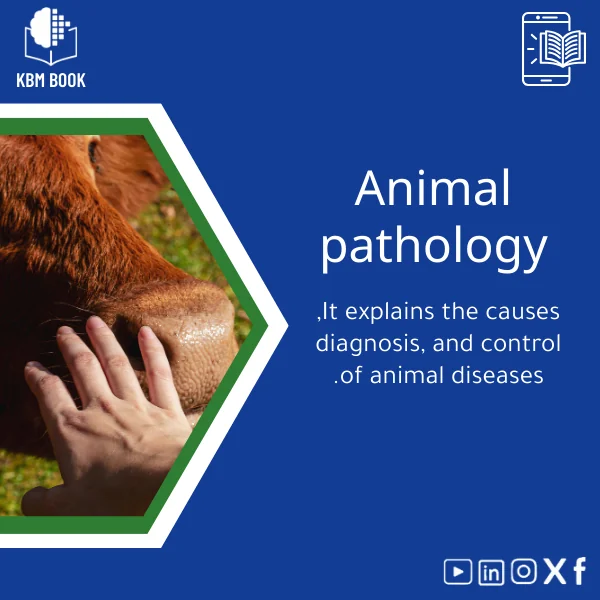
Veterinary Pathology Guide: Understanding Animal Diseases
Original price was: 349.00 $.279.00 $Current price is: 279.00 $.
A structured, searchable veterinary pathology knowledge base that explains causes, diagnosis, and control of animal diseases — designed for students, researchers, and practicing veterinarians who need rapid, reliable access to clinical pathology and disease management information.
Key benefits & value for the buyer
This veterinary pathology KBM translates complex diagnostic knowledge into a practical, re-usable resource. Instead of flipping through multiple texts or scattered articles, you get:
- Time savings: Structured modules reduce search time for differential diagnoses and lab protocols — ideal during case rounds and emergency triage.
- Consistency: Standardized descriptions and decision trees help align diagnosis across teams or students.
- Actionable outputs: Includes sample diagnostic checklists, gross and histopathology keys, and recommended tests with interpretation notes.
- Integrability: Export sections for inclusion in teaching LMS, electronic medical records, or research datasets.
- Durability: Digital KBM updates and version control mean the product remains current without bulky new editions.
Use cases & real-life scenarios
Veterinary students
Use the KBM as a study map: follow the hierarchical modules from pathology fundamentals to species-specific disease forms. Example: prepare for a pathology practical by reviewing lesion photos, differential lists, and recommended stains in a single searchable node.
Clinical veterinarians
During a sick-call, quickly retrieve likely causes and immediate sample handling steps (blood smear prep, necropsy sampling checklist). The KBM’s actionable control measures support on-the-spot decisions and client communication.
Researchers & laboratory staff
Extract curated datasets for systematic reviews, or export cutlists and histologic scoring criteria to ensure reproducible reporting in studies — saving weeks of manual collation.
Who is this product for?
The Veterinary Pathology Guide is built for anyone who needs rapid, reliable access to veterinary pathology knowledge:
- Undergraduate and graduate veterinary students seeking structured study resources.
- Practicing veterinarians and specialists needing diagnostic support during consultations.
- Pathology technicians and lab managers standardizing sampling and reporting.
- Researchers compiling disease definitions, histopathology criteria, and outcome measures.
How to choose the right KBM (format & depth)
KBMs are digital — choosing depends on how you intend to use veterinary pathology content:
- As a quick-reference book: Download the searchable PDF and index chapters by organ system for bedside use.
- For integration and research: Use the CSV/JSON exports to import structured disease fields into databases or analysis pipelines.
- For teaching: Use modular sections with slide-ready images and case studies to build lectures or exams.
If you’re unsure, pick the bundle that includes both PDF and database exports — it offers the broadest flexibility.
Quick comparison with typical alternatives
How this KBM compares to conventional formats:
- Traditional textbooks: Comprehensive but static; KBM is searchable, modular, and faster to consult in clinical settings.
- Collection of articles or lecture notes: Often fragmented; KBM removes duplication and organizes knowledge hierarchically for consistent use.
- Open web searches: Fast but variable quality; KBM is curated and cites diagnostic criteria so you can trust the entries.
Best practices & tips to get maximum value
- Start with the “Species & Sample Handling” module to ensure diagnostic accuracy from the point of collection.
- Use the exported CSV to tag frequently used disease nodes for rapid access in your EHR or study notes.
- Combine KBM case templates with your clinic’s standard operating procedures to standardize reporting.
- Review the update log monthly — KBMbook issues incremental updates when new diagnostic standards emerge.
Common mistakes when buying/using similar products — and how to avoid them
- Buying a single-format PDF only: Limits integration. Choose a bundle with database exports if you plan to reuse data.
- Assuming one KBM fits every curriculum: Verify module scope against your course or clinic protocols before purchase.
- Over-reliance without lab confirmation: Use the KBM as a diagnostic aid, not a substitute for laboratory and histopathology results.
- Skipping updates: Subscribe to update notifications to keep diagnostic criteria current.
Product specifications
- Title: Veterinary Pathology Guide: Understanding Animal Diseases
- Format: KBM (hierarchical knowledge base) with downloadable PDF, CSV, and JSON exports
- Coverage: Multi-species pathology — large and small animals; organ-based modules; infectious, metabolic, toxicologic, neoplastic categories
- Content units: Over 200 indexed nodes (differentials, lesions, protocols, case templates)
- Images: Gross and histopathology images with annotations (for teaching use)
- Compatibility: Searchable PDF, CSV/JSON for import into common LMS, EHR, or data analysis tools
- Language: English; Arabic summaries available on KBMBook for select modules
- License: Single-user digital license; contact KBMBook for institutional or classroom licenses
- Delivery: Instant download after purchase; update notifications included for 12 months
Frequently asked questions
Is this a replacement for a veterinary pathology book or a supplement?
The KBM is designed to function as both a high-quality supplement and a practical reference. It contains textbook-level explanations, but its main advantage is structuring information for fast lookup and integration. For in-depth theoretical study you may still use a dedicated textbook alongside the KBM.
What file formats are included and can I integrate them into my clinic software?
The product includes a searchable PDF for reading, plus CSV and JSON exports for integration into LMS, EHR, or data-analysis workflows. These formats are standard and easily imported into most systems; technical guidance is provided in the download package.
How often is the KBM updated with new diagnostic criteria?
KBMBook issues incremental updates as major diagnostic standards change. Purchasers receive update notifications and can download revised modules for 12 months; extended update plans are available for institutional licenses.
Is the content peer-reviewed or evidence-based?
Yes. Entries reference diagnostic criteria, common lab findings, and primary sources where applicable. The KBM is curated by practitioners and educators with clinical and academic experience in veterinary pathology.
Ready to speed up diagnosis and teaching with a searchable veterinary pathology resource?
Equip your clinic, classroom, or research project with a reliable, structured knowledge base that reduces lookup time and standardizes reporting. Instant download — start using it today.
Related products

Comprehensive Evolutionary Biology Book on Natural Selection
Comprehensive Genetics Book: DNA, Mendelian Genetics & Engineering
A structured, searchable knowledge base module (KBM) that turns genetics theory and practice into an immediately usable digital reference — from DNA structure to Mendelian genetics and contemporary genetic engineering techniques — optimized for students, researchers, and professionals who need reliable answers fast.

Cosmology Book: Guide to Big Bang and Galaxy Evolution

Electromagnetism Book: A Comprehensive Guide to Fields and Circuits

General and Special Relativity Book on Einstein’s Theory
A structured, searchable Knowledge Base Module (KBM) that converts Einstein's General and Special Relativity into a clear, hierarchical reference: formulas, derivations, worked examples, practical applications (GPS, astrophysics), and a compact research bibliography — ready to download and integrate into study, teaching, or research workflows.


Reviews
Clear filtersThere are no reviews yet.