


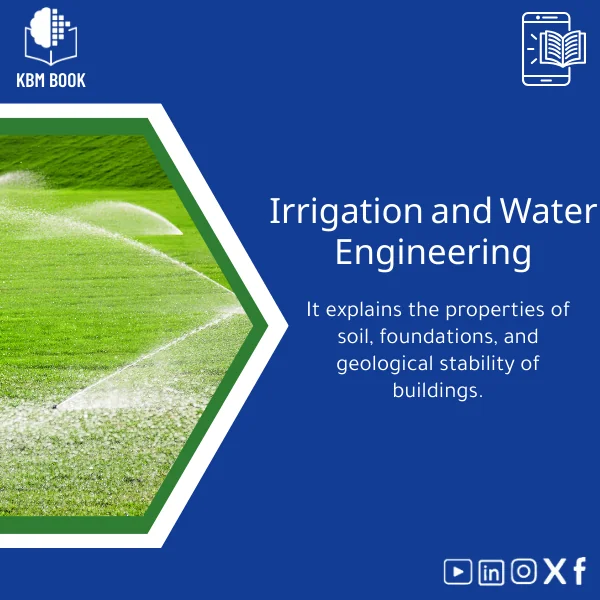
Water Resources Irrigation Engineering Guide for Professionals
Original price was: 349.00 $.279.00 $Current price is: 279.00 $.
A structured, searchable Knowledge Base Module (KBM) that converts water resources and irrigation engineering theory into a practical, hierarchical database for fast reference, network design, and applied hydrology analysis — ideal for students, researchers, and practicing engineers.
Key benefits & value for students, researchers, and professionals
This KBM turns fragmented resources—papers, code snippets, design rules, and spreadsheets—into a single, navigable framework focused on water resources irrigation engineering. Instead of searching multiple PDFs or books, you get:
- Time savings: Instant access to formulas, unit conversions, and sample calculations for the design of irrigation networks.
- Consistency: Standardized definitions and notation across modules reduce errors when sharing work or supervising students.
- Practical deliverables: Ready-to-use report templates, calculation sheets, and CAD-ready dimension tables speed project delivery.
- Transferable learning: Each module follows a stepwise path — theory, design method, worked example, and verification checklist.
Use cases & real-life scenarios
Classroom & research
Professors and graduate students use the KBM to structure courses on applied hydrology, assign reproducible design exercises (irrigation network layout, demand estimation), and compile literature reviews with annotated references.
Design offices & field engineers
Design engineers use the KBM as a quick reference when sizing canals, pipes, and control structures, selecting pump capacities, or producing tender-ready BOQs. Example: size a secondary irrigation network from catchment-runoff data using the step-by-step templates included.
Water resource managers & policy analysts
Use the KBM for scenario analysis (climate-adjusted supply-demand forecasts), prioritizing rehabilitation of canals and small dams, and preparing technical appendices for investment proposals.
Who is this product for?
Designed for students, researchers, and professionals who need a reliable water resources engineering reference in a structured, downloadable format. Specific profiles include:
- Undergraduate and postgraduate engineering students preparing design projects or theses.
- Researchers needing reproducible calculation procedures and datasets for modelling.
- Consulting engineers and technicians who require quick, defensible design decisions on-site.
- Trainers and lecturers building practical modules for professional development courses.
How to choose the right edition & format
The KBM is offered in multiple digital delivery options. Choose based on how you work:
- PDF edition: Readable, printable, ideal for study and citation (includes worked examples and diagrams).
- Data pack (CSV/JSON): Import tables (design coefficients, design curves, cross-section libraries) into spreadsheets or GIS.
- Integration pack: Templates for common modelling tools and a scriptable set of calculations for automation.
Select the integration pack if you regularly run parametric studies; pick PDF only if you primarily need a portable reference or an irrigation engineering book pdf for classroom use.
Quick comparison with typical alternatives
Compared to traditional textbooks or scattered articles, the KBM focuses on usability: modular organization, searchability, exportable data, and reproducible templates. Unlike single-topic PDFs, it connects hydrology, network hydraulics, and dam basics in one coherent database suitable for both learning and design.
Best practices & tips to get maximum value
- Start with the “Design workflow” module to align project steps before using calculation templates.
- Use the CSV tables to import standard cross-sections into your CAD/GIS environment and avoid manual re-entry errors.
- Customize report templates with your company letterhead and save as a master for tenders.
- Cross-check empirical coefficients with local standards listed in the KBM before finalizing designs.
Common mistakes when buying or using irrigation engineering references — and how to avoid them
- Mistake: Buying a generic PDF without data tables. Fix: Choose the data pack or integration pack to avoid manual transcription errors.
- Mistake: Assuming formulas are calibrated for local conditions. Fix: Use the verification checklist and adapt coefficients per the region notes included.
- Mistake: Not using reproducible templates. Fix: Use provided spreadsheets to maintain version control and audit trails.
Product specifications
- Product name: Water Resources Irrigation Engineering Guide for Professionals
- Topics covered: Applied hydrology, drainage, irrigation network hydraulics, dam basics, water distribution design, pump selection, maintenance & operation.
- Formats: PDF (readable guide), CSV/JSON (data tables), Spreadsheet templates (XLSX), Integration scripts (Python examples).
- Pages (PDF): ~420 pages of modular content and worked examples.
- Data tables: catchment coefficients, Manning tables, standard canal cross-sections, head-loss curves.
- Delivery: Instant download after purchase — single-user license with clear usage notes.
- Language: English (technical terms standardized).
- Last updated: 2025-12-02
Frequently Asked Questions
Is this an irrigation engineering book pdf or a data-first KBM?
Can I use the data tables in commercial projects?
How up-to-date are the formulas, codes, and references?
What if the KBM doesn’t fit my national standards?
Ready to streamline your water resources and irrigation engineering work?
Purchase the Water Resources Irrigation Engineering KBM and get instant access to the PDF guide, data tables, and templates that reduce repetitive work and increase design accuracy.
Instant download • Single-user commercial license • Secure payment
Related products
Analytical Chemistry Book: Qualitative and Quantitative Methods Guide

Astronomy Observational Techniques Guide for Celestial Motion

Comprehensive Microbiology Book on Bacteria, Viruses, and Fungi

Electromagnetism Book: A Comprehensive Guide to Fields and Circuits

Inorganic Chemistry Guide: Bonding and Crystal Solids
A structured, searchable Knowledge Base Module (KBM) that converts inorganic chemistry fundamentals and advanced topics—bonding models, lattice structures, defects, and solid-state properties—into a practical digital reference for students, researchers, and professionals who need fast, reliable answers without wading through textbooks.
Introductory General Chemistry Book on Matter and Reactions
A structured, searchable Knowledge Base Module (KBM) that converts core general chemistry concepts — matter, elements, reactions, stoichiometry and molarity — into a hierarchical reference you can query, teach from, or integrate into study workflows. Ideal as a concise General Chemistry book alternative for students, researchers, and professionals who need accurate, practical chemistry knowledge fast.

Materials Physics Guide: Understanding Solid-State Properties
Physical Chemistry Guide: Energy, Thermodynamics & Interactions
A structured Knowledge Base Module (KBM) for Physical Chemistry that converts core theory, worked examples, and applied datasets into a searchable, hierarchical database — ideal for students, researchers, and professionals who need fast, reliable access to chemical thermodynamics basics and molecular interaction models.
Reviews
Clear filtersThere are no reviews yet.