


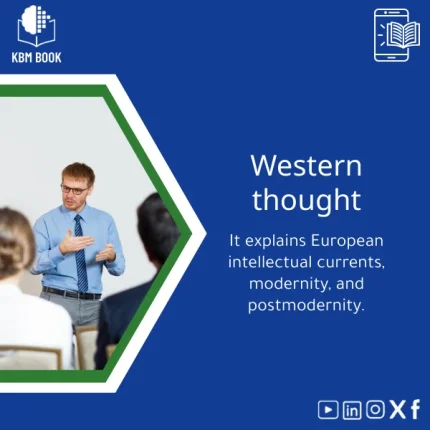
Western Thought Book: A Guide to Modern and Postmodern Ideas
Original price was: 179.00 $.139.00 $Current price is: 139.00 $.
A compact, hierarchically organized Knowledge Base Module (KBM) that maps European intellectual currents — from Enlightenment modernity to late 20th‑century postmodernity — designed for students, researchers and professionals who need fast, reliable access to structured conceptual frameworks.
Key benefits & value for the buyer
From fragmented reading lists to a single searchable KBM
The Western Thought book is not a conventional monograph — it is a Knowledge Base Module that converts scattered sources into a consistent, hierarchical database. Instead of flipping through multiple texts, you get:
- Concise concept pages: Clear definitions and timelines for major movements (Enlightenment, Romanticism, Modernism, Structuralism, Poststructuralism, Postmodernity).
- Profiles & primary sources: Summaries of key thinkers with citation-ready extracts for essays and presentations.
- Comparative maps: Side-by-side contrasts (e.g., modernity vs. postmodernity) to help form thesis arguments quickly.
- Search and export: Fast keyword lookup and PDF download for offline use — ideal when internet access is limited.
These translate to measurable time savings in research, clearer lecture planning, and more focused literature reviews.
Use cases & real-life scenarios
Academic assignments
Students can extract structured notes to form literature review sections, generate annotated bibliographies, and draft thesis outlines with accurate historical context and citations.
Research & writing
Researchers needing a quick refresher on theoretical frameworks (e.g., Foucault’s archaeology, Lyotard’s incredulity toward metanarratives) will find ready-made summaries and cross-references to relevant primary texts.
Teaching & curriculum design
Lecturers and trainers can pull modular lesson units or slides, saving hours in syllabus development while ensuring conceptual accuracy and progression from basics to advanced critique.
Professional reference
Policy analysts, cultural sector professionals, and content strategists can use the KBM as a reliable quick-reference to situate ideas in a European intellectual tradition.
Who is this product for?
The Western Thought book targets:
- Undergraduate and graduate students in philosophy, history, cultural studies, and literature.
- Independent researchers producing essays, articles, or policy briefs.
- Lecturers and curriculum designers needing modular teaching content.
- Professionals requiring quick, validated conceptual summaries for reports or client work.
If you need to buy Western Thought book materials that are structured, citable, and immediately usable, this KBM is built for your workflow.
How to choose the right format
This product is offered in two delivery options to match different workflows:
- Interactive KBM (recommended): Fully searchable database, interlinked entries, exportable sections. Best for active research, teaching, and iterative editing.
- Western Thought PDF download: Linear, print-ready PDF of the full module. Best for offline reading, annotation, and submission with reference lists.
Choose the interactive KBM if you plan to integrate the module with writing tools or frequently update notes. Choose the PDF if you prefer a portable, printable reference.
Quick comparison with typical alternatives
Many buyers compare KBMs to textbooks, lecture slides, and academic articles. Here’s how this Western Thought book compares:
- Vs. textbooks: More modular and searchable; avoids long narrative chapters in favor of bite-sized, citable entries.
- Vs. lecture slides: Far more comprehensive and self-contained; slides may omit nuance and sources.
- Vs. article collections: Articles are deep but isolated; the KBM synthesizes and cross-references across the field.
If your priority is quick retrieval and structured synthesis across intellectual currents, the KBM format offers higher practical value.
Best practices & tips to get maximum value
- Start with the timeline and glossary pages to orient yourself before diving into thinker profiles.
- Use the cross-reference links when drafting comparative sections — they reduce citation search time.
- Export module subsections as PDF snippets for specific assignments instead of printing the entire file.
- Annotate exported PDFs with your comments; keep the KBM unchanged so you can re-export fresh copies for new projects.
Common mistakes when buying/using similar products and how to avoid them
- Mistake: Buying a single textbook expecting comprehensive coverage. Fix: Choose a KBM that explicitly maps movements, thinkers, and primary sources.
- Mistake: Overlooking format needs (interactive vs PDF). Fix: Match the product format to your workflow before purchase.
- Mistake: Assuming summaries replace primary reading. Fix: Use the KBM as a scaffold and consult primary texts where required for depth.
Product specifications
- Formats: Interactive KBM (searchable database) and PDF download
- Language: English
- Coverage: Enlightenment → Romanticism → Modernism → Structuralism → Poststructuralism → Postmodernity
- Content units: Glossary, Timeline, 45 thinker profiles, 120 concept pages, 60 primary-source excerpts
- File size: PDF approx. 6–12 MB (depending on export); KBM scalable via web interface
- Compatibility: Desktop and mobile browsers; PDF for any standard reader
- License: Personal, academic, and classroom use permitted; commercial reuse requires permission
- Updates: Periodic content updates; purchasers receive version notifications
FAQ
Can I get a Western Thought PDF download after purchasing the KBM?
Yes. The interactive KBM includes a built-in exporter so you can generate a PDF of the entire module or selected sections for offline use.
Is the KBM suitable as a primary source for academic citations?
The KBM provides structured summaries and includes citation-ready references and primary-source excerpts. For formal citation of arguments, cite the original primary texts alongside KBM entries where appropriate.
How often is the content updated?
Content is reviewed periodically and updated to reflect scholarly consensus and new translations. Purchasers receive update notifications and can download revised exports.
What if I only need a specific module (e.g., Postmodernity)?
You may export or purchase individual subsections depending on availability. Check the product page options or contact support for a modular purchase.
Ready to streamline your research and teaching?
Purchase the Western Thought book as a searchable KBM or download the Western Thought PDF. Gain instant access to a structured, citation-ready knowledge base that saves time and clarifies complex debates.
Related products
Comprehensive Botany Book on Plant Taxonomy and Photosynthesis
A structured, searchable botany book designed as a Knowledge Base Module (KBM) — an end-to-end reference on plant taxonomy, organ structure, and the biochemistry of photosynthesis. Built for students, researchers, and professionals who need reliable, hierarchical knowledge they can search, cite, and apply immediately.

Comprehensive Evolutionary Biology Book on Natural Selection

Comprehensive Microbiology Book on Bacteria, Viruses, and Fungi
Cosmology Book: Guide to Big Bang and Galaxy Evolution

Inorganic Chemistry Guide: Bonding and Crystal Solids
A structured, searchable Knowledge Base Module (KBM) that converts inorganic chemistry fundamentals and advanced topics—bonding models, lattice structures, defects, and solid-state properties—into a practical digital reference for students, researchers, and professionals who need fast, reliable answers without wading through textbooks.
Physical Chemistry Guide: Energy, Thermodynamics & Interactions
A structured Knowledge Base Module (KBM) for Physical Chemistry that converts core theory, worked examples, and applied datasets into a searchable, hierarchical database — ideal for students, researchers, and professionals who need fast, reliable access to chemical thermodynamics basics and molecular interaction models.
Quantum Mechanics: A Beginner’s Guide to Superposition and Waves
Thermal Physics Guide: Understanding Heat, Energy, and Entropy
A downloadable, hierarchically structured Knowledge Base Module (KBM) that converts university-level thermodynamics into a searchable, practical digital database. Ideal for students, researchers, and professionals who need fast, reliable access to fundamentals and advanced topics in thermal physics.
Reviews
Clear filtersThere are no reviews yet.